


Executive summary
In March 2025, a leading global exchange switched on an AED bank-transfer channel for its UAE users. Deposit dirhams from your own bank account, hold USDT/C for investing or trading in the market with digital assets like BTC/ETH, and convert it back into AED when you want fiat again. Nothing like it existed on any Tier-1 exchange in the country before.
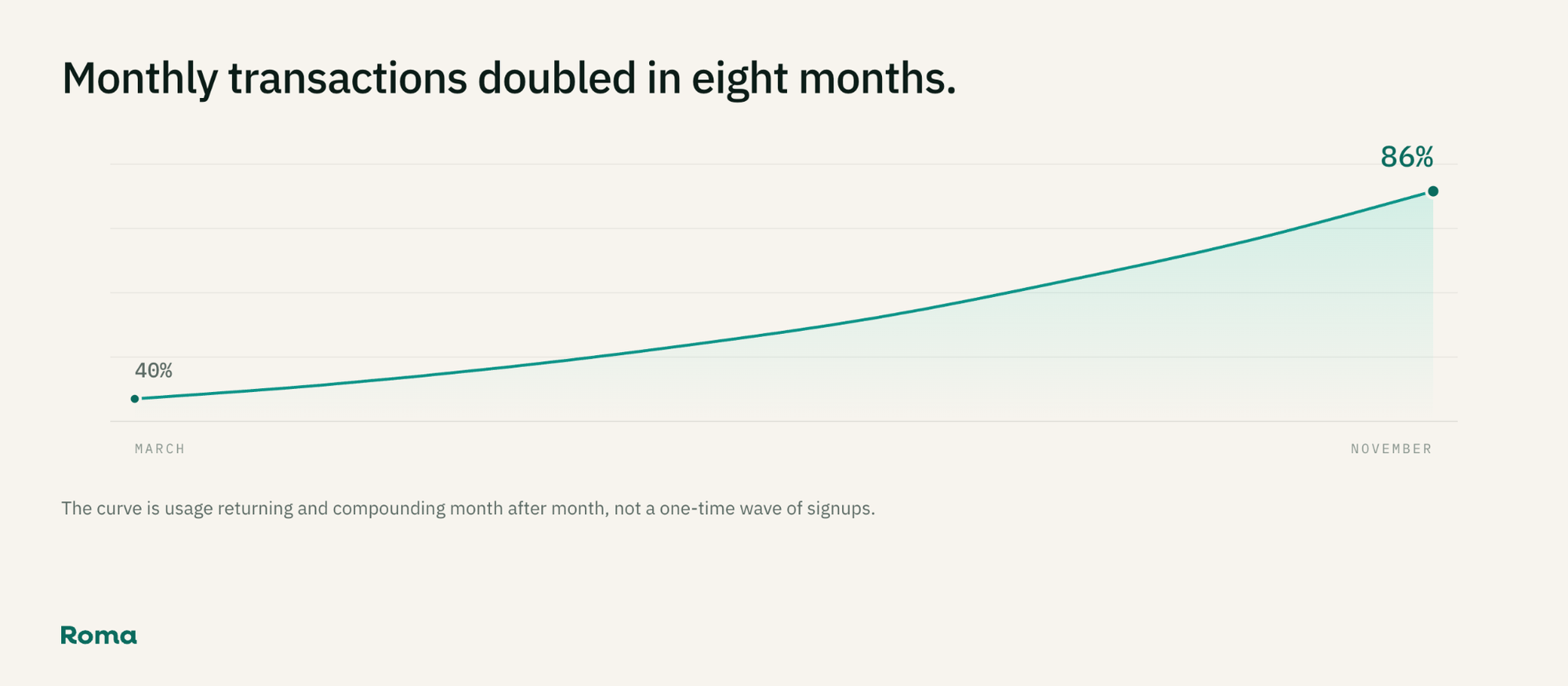
Roma enabled this at scale for this exchange to be run collaboratively. Eight months in, the channel has processed over $250M across more than 50,000 transactions and onboarded 42,000+ KYC-verified users. Monthly transactions consistently doubled, growing month on month, from about 4,000 to ~8,600.
Measured impact
Global crypto exchange in the UAE
One of the largest crypto exchanges in the world, processing around $80B in trading volume on any average day. In the UAE it operates under a regulated exchange licence and serves both retail and institutional users out of Dubai, where it is the default go-to platform for most people who trade.The access to stablecoins using their local AED is the ultimate entry point for anyone into the world of digital assets. For a UAE business especially, the ability to use AED to buy USDT/C opens them up to trade or invest in any digital asset on this exchange platform, breaking geographical and payment barriers.
What the exchange’s users were stuck with
Until early 2025, there was no regulated bank-transfer route for a UAE user to buy or sell USDT and USDC with Dirhams (AED). That left three separate problems, and they compounded.
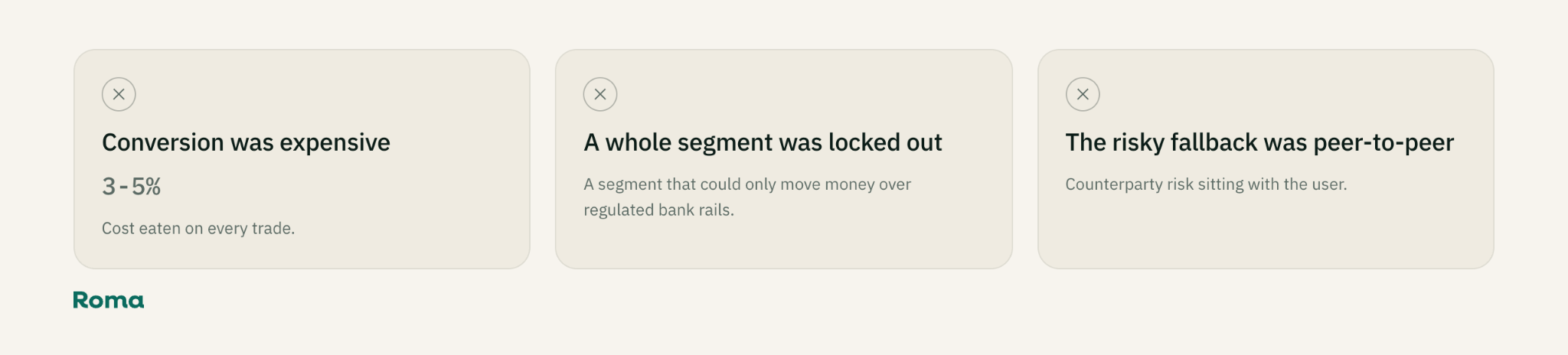
Conversion was expensive. Card and Apple Pay worked, but that cost the users 3 to 5 percent on every transaction, eating into the value of each trade.
A whole segment was locked out. A large section of potential users in the UAE were comfortable moving money only over regulated bank rails, and none of them could do it reliably.
The risky fallback was peer-to-peer. Peer-to-peer was accessible but it left significant counterparty risk with the user, and it was an unfamiliar mode than what most users are comfortable with.
Implementing all the above required a licensed institution in the UAE, live integrations with local banks, and a dedicated and serious AML infrastructure which holds up to rigorous regulatory scrutiny. In early 2025, very few companies had one of the three.
How the exchange found Roma
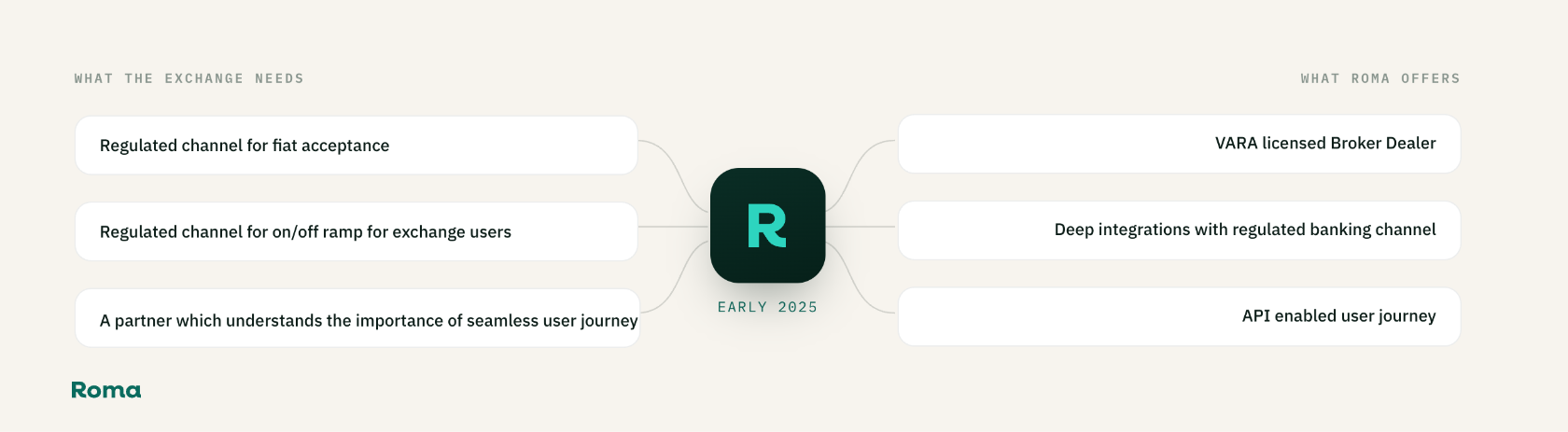
The timing landed well. The exchange firm was working out what a regulated AED route would need behind it, and Roma had just finished putting those exact pieces in place in the UAE: a licensed entity as a Virtual Asset Service Provider (VASP) with Dubai's VARA, direct integrations with local banks, and a robust compliance engine built for this problem.
What settled it was less the feature list than the willingness to build collaboratively. Both sides understood they were designing a customer journey, and a regulatory posture to go with it, that had to work at market scale.
What Roma built for the exchange’s UAE users
Roma became the bridge between fiat and stablecoins, carrying onboarding, the on-ramp, the off-ramp, settlement and compliance in one place, so the exchange wired it in once instead of assembling a stack of providers and reconciling between them. Every build since, the off-ramp included, has shipped without a second integration cycle.
The build ran in sequence. The on-ramp went first: a user sends AED by bank transfer, Roma receives the funds and credits USDT/C to their B wallet. Once volume had grown on that leg, the off-ramp closed the loop, converting stablecoins back to AED and paying out to the user's own local bank account, settling instantly.
Onboarding was optimised for speed without giving up compliance, which puts a new user's first transaction less than fifteen seconds after sign-up rather than days later.
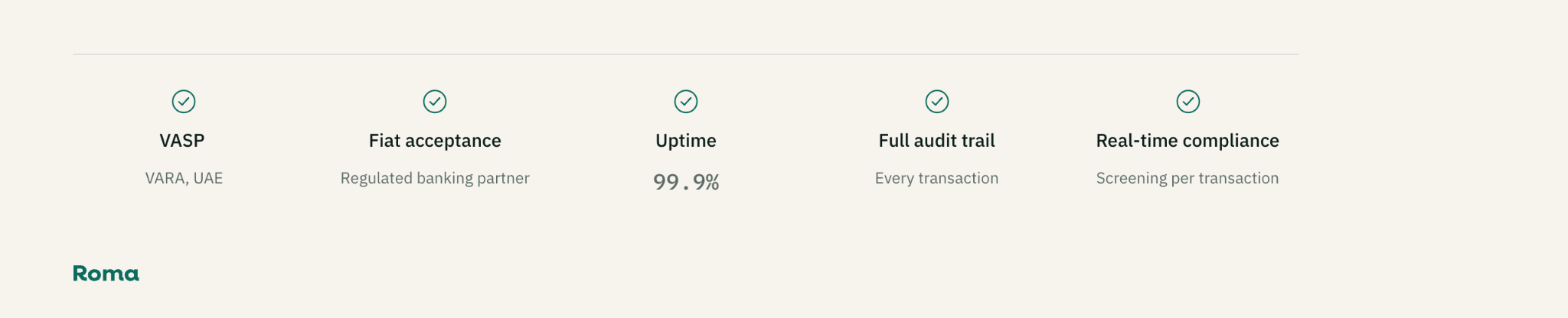
Behind it sits real-time compliance on every transaction, IBAN whitelisting, identity-linked bank accounts, a full AML trail on every transaction and 99.9% uptime. Roma's VASP licence carries the UAE regulatory work as well, covering transaction reconciliation, regulatory reporting and record-keeping, so the exchange meets its obligations in the corridor without building an entire function for it.
The rest is partnership rather than engineering. Because the channel runs through a licensed institution, Roma is the default AED route across the exchange's app, website, support docs, FAQs and product flows, with users sent to Roma directly. The exchange owns the trading half of the relationship, Roma owns the money movement and the support behind it, closing user questions on the AED flow in under three business hours.
How the exchange felt Roma’s impact
The accessibility gap that had blocked the UAE market was exactly what Roma had solved for
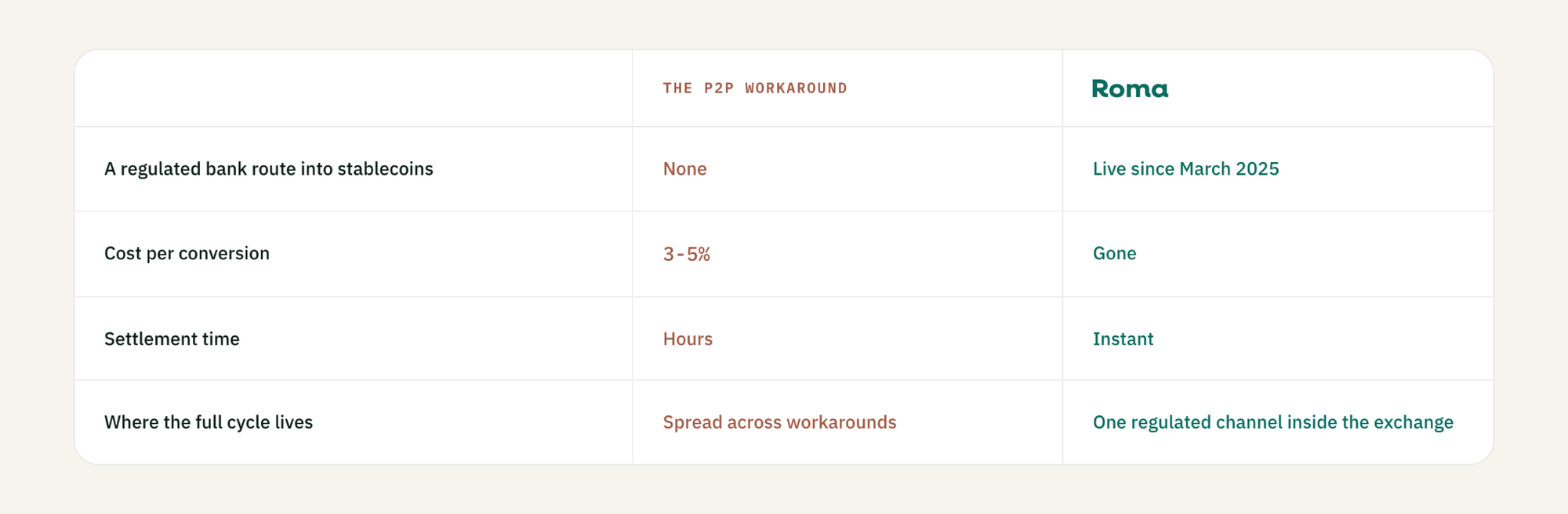
The full Dirham cycle now sits in one place. Users deposit AED, buy stablecoins like USDT/C, to invest or trade digital assets like BTC/ETH using those, and convert them back to AED when required to withdraw to their local bank, all through one regulated channel inside the exchange. Every leg of it passes through a licensed institution with real-time monitoring, identity-linked accounts and a clean audit trail, settling instantly against P2P timelines measured in seconds or minutes. The 3 to 5 percent conversion cost that users used to absorb on every transaction is gone.
Over time, there was a steady increase in the number of KYC’ed users and number of transactions that users undertook. This served as the best proof of the engine running with more and more users signing up and being able to transact within 15 seconds of their coming to the platform
Reliance Model
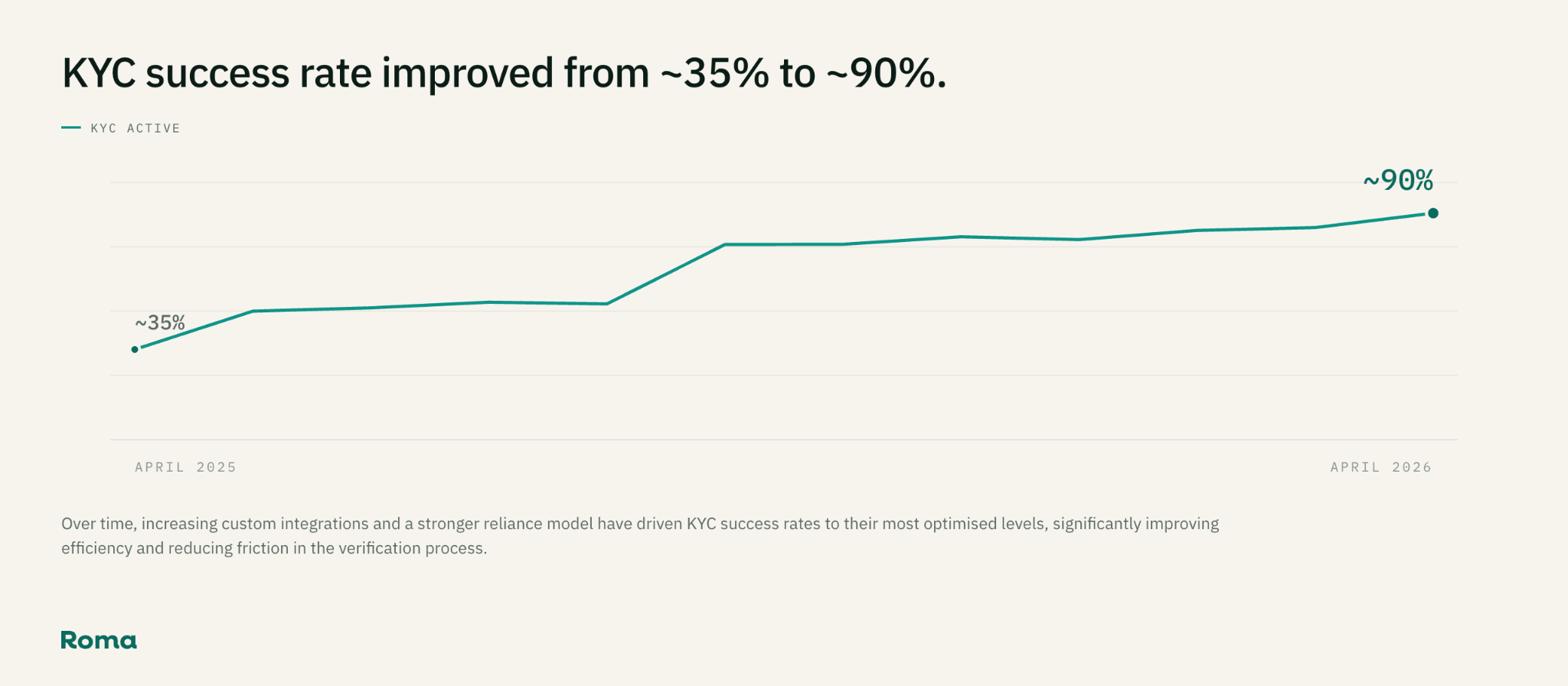
After building transaction volumes and user confidence in Roma's compliance framework, Roma worked closely with VARA over the following months to develop a tailored reliance model for the exchange and its users. This enabled the exchange to offer a more seamless trading experience while maintaining the required regulatory controls. The model was a significant unlock, improving the user journey while supporting compliant and scalable trading.
What Roma has in store for enterprises like this
If you run an exchange in a market where fiat currency cannot be converted to stablecoins over a regulated rail, the hard part is rarely the technology. It takes a licence, live bank connections and real infrastructure in the same place, and building all three yourself takes years.
Three things are worth taking from it:
- Go live with the full user journey from day one. Enable fiat deposits to named accounts with single API for onboarding, on-ramp, off-ramp and instant settlements from day one.
- Eliminate friction to unlock true user adoption.Ensuring users are onboarded compliantly and instantly maximises a user’s adoption and unlocks their experience with investing/trading in digital assets.
- Build with a regulated partner who understands scale.Roma carries the licence, the bank connections, transaction screening, and the reporting, so you don’t have to build a compliance function specifically for UAE.


